



Transformation
Transformation has many definitions. But I believe the following will suffice for the points I am trying to make here. Cambridge defines it as “a complete change in appearance or character of something or someone, especially so that it is improved.” The question for you to consider, is my organization and our leaders adapting and transforming based on the changes taking place around us? Let’s look at some of the changes taking place.
Demographic Wave Change
The world and the U.S. in particular are facing a demographic change and wave. It is aging, and the four generations behind it are increasingly diverse. This has implications for society, organizations, their workforce, and their consumer. This makes Diversity, Equity, and Inclusion (DEI) an organizational imperative and strategic enabler for the success of present and future organizations.
Today’s society and workforce are increasingly older and multigenerational, with the aging baby boomers and now four generations in the workplace. Presently, there are more 60-year-olds than 5-year-olds (Taylor & Lebo, 2019). It is estimated that to maintain stable population growth and to replace today’s workforce, countries need a 2.1 replacement rate. This includes births, deaths, immigration, and emigration (The Longevity Economy, Coughlin, J., 2017). The United States just dropped to 1.6 after being at 2.0 for the last several years. The added skills shortage adds another challenge for organizations.
DEI’s Tipping Point
DEI took a prominent role for the U.S. and organizations after the George Floyd incident. While it had been in organizations in different capacity for many years, the Floyd incident pushed it front and center. Many organizations began to emphasize its importance and started to hire diverse professionals at all levels.
Unfortunately, this also created push back from some, and this pushback grew to terms such as woke and politically correct. The change in Washington did not help its cause. It eventually became a politically charged term, causing divisions and consternation among many. Many of those same organizations that proudly highlighted their DEI efforts, distance themselves from it, if not completely pushed it underground. There is new change coming to Washington, we’ll see what impact it may have.
This change is taking place in spite of the numerous and various business cases made for DEI. Research has highlighted how diverse management teams increase revenue, profitability, make better decisions, and lower turnover. All focused on the bottom line, reducing costs, improving shareholder value, and increasing market share, which highlights why DEI should be considered a business imperative. Some might argue, because those in power see the change coming and they are resisting it. Others might say this is a way to make DEI just die and go away.
While DEI may have outlived its time for a variety of reasons, the demographic wave will not go away. Organizations will need to addressing their aging, multi-generational, multicultural, and ethnic changing workforce. Leaders will need to consider their role as one of a Director of an Orchestra. This director is responsible for creating beautiful music from diverse instruments and diverse musicians. In a similar fashion today and tomorrows leaders will need to bring the best out of the diverse changing workforce to achieve organizational objectives.
Make room for Artificial Intelligence (AI)
Depending on who you read or listen to, you’re going to get different versions of what the future will hold when it comes to AI for organizations and humanity overall. One is that AI will eliminate jobs, which is to be expected, and we’ve been here before. When the PC came into existence, it eliminated 3.5 million jobs and created 19 million. The World Economic Forum estimates that AI will eliminate 92 million jobs and create 170 million by 2030.
The point to keep in mind is to address these changes strategically and with critical thought, and not to do what some have already done. IBM laid off 8000 employees due to AI, only to have to rehire them because of the extra work AI created. So yes, AI will eliminate jobs, but it will also create others.
I believe AI will be a very advanced form of technology that will eliminate redundant jobs that most do not want to do and enhance other capabilities. Which means many will need to be reskilled. Just like the PC did when it came into existence.
Microsoft, an IT organization, even highlighted that some of the primary skills needed in the future will be emotional intelligence, flexibility, bias detection, and analytical judgement, among others. In other words, the interpersonal skills. IBM has a White Paper supporting this point, where organizations that create better human experiences by enabling human-centered organizations will achieve higher revenue and outperform S&P 500 organizations. Again, emphasizing the power of skills (interpersonal skills) complemented, not replaced by AI and technical skills.
The Need for Human Intelligence (HI)
Organizations are facing a lot of change, and this leads to uncertainty, which has become the defining word in 2025, the second time in 35 years, only to the pandemic, and made worse by changing demographics and the exponential growth of AI. All of this lines up to create a perfect human capital storm and an opportunity or challenge for organizations and their leaders.
There is a changing psychology and a different set of expectations from organizations and leaders. Today’s workforce is feeling overworked, burned out, and more prefer remote/hybrid or a 4-day workweek and flexibility. This is while some managers consider remote workers less productive and promotable. For 70% of today’s workforce, their biggest stressor is their boss. This is impacting employee engagement, which has reached a 10 year low and costing companies $7 trillion in lost productivity, causing higher absenteeism, more accidents, more errors, and lower productivity. These are not issues that AI will address, but leadership can.
Today’s workforce is looking for appreciation, purpose, autonomy, well-being, meaning, and happiness at work. In the growing era of change, demographically and with AI, leaders will need to be compassionate, empathetic, and listen and communicate better, all human factors which AI cannot replace. When this happens, employees are more trusting, committed, satisfied with their job, and feel psychologically safe.
When leaders create high trusting organizations, their workforce is less stressed, more energetic, more productive, more engaged, and feel less burnout. This is why I’ve identified what today’s and tomorrow’s organizations are going to need with their HI, and that is to create a human intelligent workplace. I define it in the following manner.
HUMAN INTELLIGENT (HI) WORKPLACE
A Human Intelligent (HI) Workplace is defined as one where leaders model effective leadership behaviors by creating an organizational culture where the workers’ experience is one of being engaged while collaborating with their diverse team members.
It is a workplace where the workforce feels psychologically safe when raising different perspectives, taking risks, being innovative, and/or being creative. It is a workplace where the workforce feels listened to and understood by their leaders. Itis a workplace where the workforce finds fulfillment in the work they do and, in the organization, they work in.
Does this describes your organization, and would your workforce agree?
The Business Case for Humans in Organizations
It has been highlighted in numerous books, writings, research, and examples like those of Great Place to Work organizations that when organizations, through their leadership and organizational culture, create a healthy workplace, it pays off. Just consider the following:
1. Today’s workforce is looking for autonomy, doesn’t want to be micromanaged, purpose, to do something bigger than a paycheck- and mastery, to continue to learn. They are looking for happiness at work, to be appreciated; a simple thank you, which is free, ranked higher than pay in a study of 200,000 workers worldwide, per the TED Talk by Boston Consulting Group, The Workforce Crisis of 2030.
2. Disengagement is costing companies $7 trillion in lost productivity. It produces higher absenteeism, lower productivity, lower profitability, and higher turnover. Turnover alone can cost over 150% to 400% of an employee’s salary. In addition, 70% of leaders experience significant stress, and for 70% of the workforce, their manager is their biggest stressor.
3. On the other side, in high-trust organizations, people are less stressed, more productive, more engaged, and are prone to less burnout. A happy employee tends to be less sick, less absent, more loyal, and more creative. This tends to be seen in Great Place to Work organizations, where employees tend to achieve over 8 times more revenue than those not in these types of organizations.
4. It has been pointed out that organizational culture is a reflection of leadership. Organizational change is going to be needed, and yet 66% of change efforts fail to achieve their goals. To transform, leaders are going to have to use their HI, create a more human centered workplace, and demonstrate effective leadership. Leaders need to recognize that they and their workforce are neurologically wired to resist change. We as humans prefer certainty. Leaders need to explain the “why” for the change and how the change will impact their workforce.
Transformation from DEI to AI to HI will require Leadership
In order to achieve and adapt to these changing and transformational times, organizations will need leadership. Leaders that model effective behaviors in the following manner.
Leadership
“Leadership is the capacity of an individual in a managerial position to positively influence, engage, and motivate their workforce. One where they demonstrate empathy, compassion, listen to understand, rather than respond, is trustworthy, authentic, and creates a psychologically safe environment. One where they create clarity and minimize uncertainty as much as possible during organizational change. In summary, a leader is one who creates an environment where the workforce feels engaged.”
The questions for you to consider are the following:
- Is your organization adapting and transforming from DEI to AI to HI?
- Is your organization a Human Intelligent Workplace as described above?
- Are your leaders modeling HI through their behaviors as in the definition above?
- Will your workforce describe and align with the definitions above for your organization and leaders?
Interesting questions for you to reflect on, so you can ensure your organization does not become the Blockbuster or Circuit City of the future. Just a footnote: Circuit City was in the book Good to Great, which was about what the author considered the best organizations of its time and reinforces the point that success today does not guarantee presence tomorrow.
Organizations have always transitioned and transformed through change, driven by societal, human, and technological changes. So as we transform from DEI, through AI, will HI prevail? I believe and hope so.
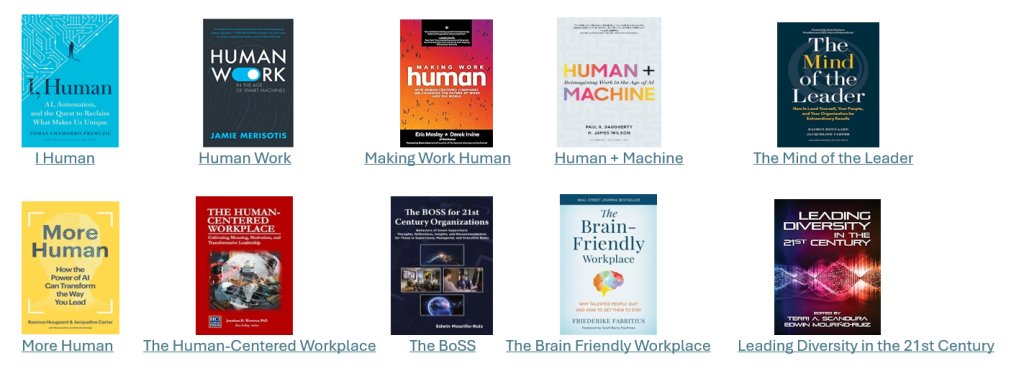
In addition, for your consideration, I’ve highlighted some books below can help you as you consider your organization’s transformation. All with the flavors and importance of DEI, AI, HI, and leaderdership
ABOUT THE AUTHOR
Edwin Mourin᷁o – Ruiz, Ph.D.
Dr. Edwin Mouriño is an Air Force veteran, author, Human Capital, and DEI practitioner and speaker. As a human capital practitioner, Dr. Mouriño’s focus has been on helping leaders and organizations help themselves. He is an experienced professional with many years of leading and/or supporting key elements of organizational change projects. Dr. Mouriño is an Air Force veteran who began his career in Diversity Equity and Inclusion (DEI) as a graduate of the DOD-Defense Equal Opportunity & Management Institute (DEOMI) and has also been a speaker.
He brings broad industry experience that includes Fortune 100 companies. He is the founder and president of Human Intelligent (HI) Workplace, an organization focused on helping leaders help themselves through leadership, team development, and executive coaching. He has been and continues to serve as a college professor. He is also a Senior Fellow with the Conference Board on the DEI and Leadership Steering Committees.
He has extensive experience and thought leadership on Human Capital issues and supported organizational change efforts through Leadership Development, DEI, Executive Coaching, Team Development, Executive Retreats, Personality Assessments, and Organizational Change. He has spoken at numerous professional venues and written numerous articles on human capital trends impacting organizations, specifically addressing DE, and is the author and co-editor of several books.



0 Comments