
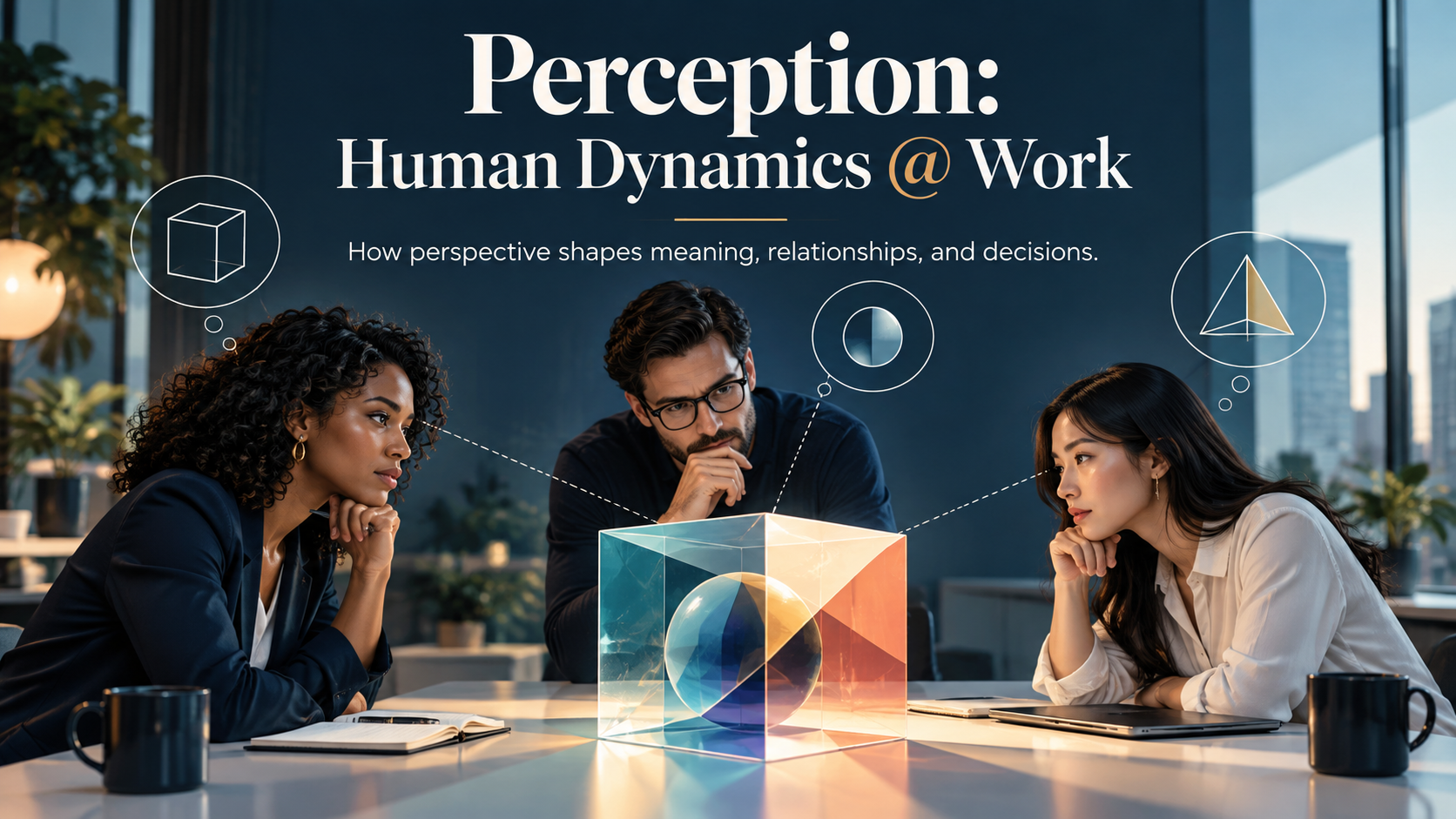




There are many definitions of perception. I believe the following provide a good basis. Perception refers to the process by which sensory information is interpreted and transformed into meaningful experiences. Another definition is the ability to see, hear, or become aware of something through our senses. Whichever you prefer, or any other, it sort of lays out for us how we see and interpret the world.
Why do I even write about a topic that some might consider a pretty fundamental topic? Because I believe now more than ever, in an increasing era of Artificial Intelligence (AI), constant needed organizational change, growing uncertainty, changing demographics that include an aging workforce, a changing psychology and expectation of today’s workforce, and how we perceive the world around us and those we interact with, will make this concept even more important.
Today’s workforce is expecting their leaders to care about them, to listen to them, to work in a place where they feel cared for and appreciated. Yet for 70% of the workforce, their leader is their biggest stressor, not surprising since 70% of leaders are increasingly burnt out. Increasingly, workers feel less listened to, with one study highlighting that only 5% of leaders considered effective communicators and listeners.
Today’s workforce wants a workplace and organizational culture where they are engaged, have autonomy, are continually learning, feel psychologically safe, and want to work for more than a paycheck, to work for a purpose. Even in the growing era of AI, the skills needed for today and going forward are leadership and social influence. They want leaders who understand their perspective and issues. Work-life balance has evolved to work-life integration, especially after the Pandemic. This has led to a need for leaders who are empathetic and compassionate.
Unfortunately, in more cases than needed, senior executives see things one way, mid-level managers another way, and front-line employees another way. It’s almost like they are in three different organizations. In one study, both executives and front-line employees were asked to rank ten items, one being employee well-being. They were to rate them from 1-10, with one being the most important and ten being the least. Unfortunately, not surprisingly, the executives ranked employee well-being 8, and the employees ranked it 3 (not sure why not one).
This study became a reality for me when I spoke to a group of executives. I asked them to rate themselves as effective leaders, to rate their managers, and to share how they thought the workforce would rate management. I used the scale of 1-5, with 1 being poor and 5 being excellent. As a group, their average score was 4.5; they rated their managers 3.9, and thought their workforce would rate management 3.5. In other words, I’m good, our managers need help, and our employees believe they need help. I wish I could have conducted this same assessment from the employee’s perspective. I do believe it would have been enlightening. I call this gap the Perception Phenomena.
It does not help that we have unconscious biases. This may lead us to see something one way, favorable or not, and others to see things differently. As I like to remind my listeners, students, and participants, we see the world not as it is, but as we are. I believe this is going to require organizations to take a systemic approach that enlighten, educate, hold accountable, and reward their leaders to be more aware of what I’ve highlighted up to now. I believe it will need leaders that demonstrate effective leadership as defined below.
Leadership
“Leadership is the capacity of an individual in a managerial position to positively influence, engage, and motivate their workforce. One where they demonstrate empathy, compassion, listen to understand, rather than respond, is trustworthy, authentic, and creates a psychologically safe environment. One where they create clarity and minimize uncertainty as much as possible during organizational change. In summary, a leader is one who creates an environment where the workforce feels engaged.”
It will require leaders to be more sensitive to their own points of view and those of others. To sometimes even question their own perception of a situation and be open to other perspectives. Recognizing the above will be a beginning. Because leaders need to remember that leadership starts with the mind. Their mind determines their choices, their choices determine their actions, and their actions shape their leadership behaviors. No AI will be able to replicate this. In the growing era of AI and uncertainty, organizations will need leaders who are increasingly aware of their human strengths and weaknesses, of the value of their perceptions along with their frailties. To remember that we see the world not as it is, but as we are.


0 Comments