
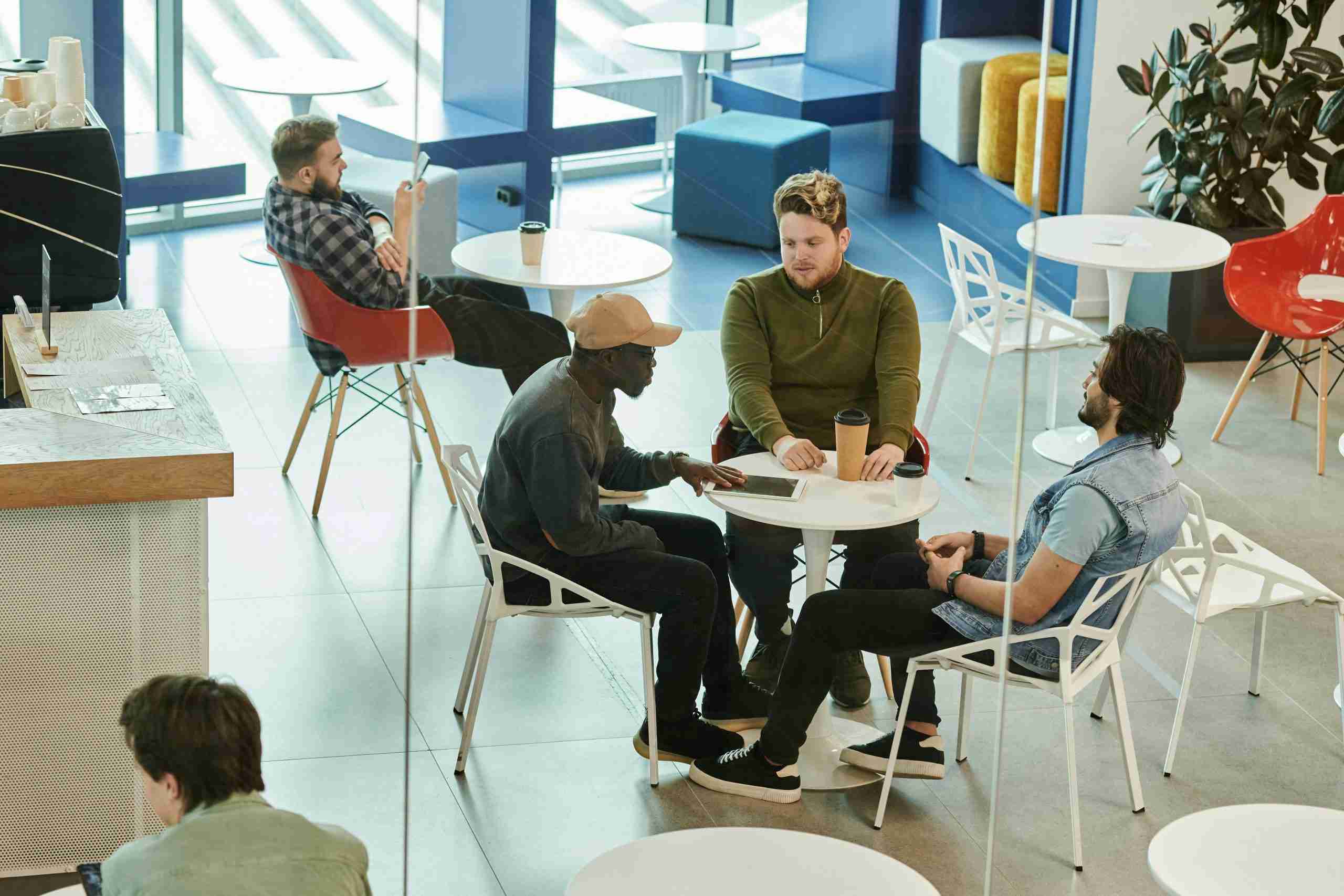


Many years ago, when I was in high school, I experienced something that at the time I thought was just a once-in-a-lifetime experience for me. I later learned that this was not the case. I attended Catholic school while growing up in New York City. The high school I attended at the time had 750 boys, with 95% of them being white boys. There was a small group of Latinos, a few African Americans, and one Asian boy that I can remember. I recall no racial tensions. Everyone (with the exception of the occasional bully) pretty much got along.
Early on in our freshman year, I was having lunch with some classmates. We had priests who were called Brothers. The principal came by as he always did at lunch time, and this one particular day, he stopped by the table where there were a few of us eating lunch. He leaned over into the middle of the table and whispered to us, “I want you all to mingle around with others in the cafeteria”. I did not know what he meant until I looked around my table. I happen to be sitting around having lunch with other Latino boys. I had not realized until he pointed it out that we, the Latino kids, were used to having lunch together. It was not intentional, but more unconscious.
Years later, after being in the Air Force for a few years, I changed careers and entered what was titled Social Actions. My role was to serve as a consultant, counselor, and leadership development professional in what was then related to human relations. Today, this is called Diversity, Equity, and Inclusion (DEI). After working there for a while, I joined the corporate world, working in leadership development and addressing DEI issues.
Over time, as I worked with many in different industries and organizations addressing the issue above in particular, inclusion and exclusion, I rediscovered what I thought had only happened to me earlier in my life. I rediscovered what I’ve titled “The Cafeteria Experience”.
You see as I worked with different clients, they too started to share this experience. Someone even once said that the cafeteria time exposes how we migrate and separate into our own groups. Whether this be men, women, white collar, blue collar, different professions (Engineers, Accountants, Human Resources, etc.), different ethnic groups (Anglo, Latino, African American, Asian, etc.), having lunch separately.
While I am pointing this out, I am not doing so to judge anyone. I do so, just to point it out. Because, as much as has been written, spoken about, and educated to many, diversity can positively impact an organization, its organizational culture, and its bottom line. We as humans still look to be around those who are like us.
The Neuroleadership Institute came up with an acronym to highlight the five unconscious biases that we as humans have. It is called SEEDS. It stands for Similarity, Experience, Expedience, Distance, and Safety. That we tend to associate more with those who are similar to us or have similar experiences, without realizing it, is unconscious.
So the questions to consider are the following.
1. Are you seeing the cafeteria experience in your organization?
2. Is the cafeteria experience good or bad? Why or why not?
3. Does the cafeteria experience matter as the world and, in turn, organizations become increasingly multi-generational as we have an aging society and workplace, and multi-cultural as we have an increasingly more diverse younger society, workforce, and workplace?
4. Are we as humans just neurologically wired this way, hence migrating toward those that are similar to us? How will this help or hinder DEI initiatives?
5. Is your organization addressing DEI from a systemic perspective?
Irrespective of where you end up on these questions, it provides you with a starting or continuation point as you address your organizational human capital issues. Because there is a perfect human capital storm brewing with changing workforce demographics, changing psychology of today’s workforce, expectations of its leaders, and the growth of AI. How you address these going forward will position your organization to gain a competitive advantage or not
ABOUT THE AUTHOR
Edwin Mourin᷁o – Ruiz, Ph.D.
Dr. Edwin Mouriño is an Air Force veteran, author, Human Capital, and DEI practitioner and speaker. As a human capital practitioner, Dr. Mouriño’s focus has been on helping leaders and organizations help themselves. He is an experienced professional with many years of leading and/or supporting key elements of organizational change projects. Dr. Mouriño is an Air Force veteran who began his career in Diversity Equity and Inclusion (DEI) as a graduate of the DOD-Defense Equal Opportunity & Management Institute (DEOMI) and has also been a speaker.
He brings broad industry experience that includes Fortune 100 companies. He is the founder and president of Human Intelligent (HI) Workplace, an organization focused on helping leaders help themselves through leadership, team development, and executive coaching. He has been and continues to serve as a college professor. He is also a Senior Fellow with the Conference Board on the DEI and Leadership Steering Committees.
He has extensive experience and thought leadership on Human Capital issues and supported organizational change efforts through Leadership Development, DEI, Executive Coaching, Team Development, Executive Retreats, Personality Assessments, and Organizational Change. He has spoken at numerous professional venues and written numerous articles on human capital trends impacting organizations, specifically addressing DE, and is the author and co-editor of several books.

0 Comments