



Aging World and Workplace
In case you’ve missed or have not heard, there is an aging world, society, and in turn, workforce. Presently, there are more 60-year-olds than 5-year-olds, and every day in the U.S., 10,000 turn 65. This has implications for countries, society, and organizations. This is mainly because we’re living longer than ever before. In the early 1900s, the average life span was 47, and today it is up to 87. The Blue Zones highlight the five areas of the world where there is the largest concentration of centurions (those living longer than 100 years).
It is no longer just an exception that people can live 20 to 30 years past the age of 60. Forbes came out with an article in 2023 that the fastest growing demographic in the workforce were those over the age of 75. In the book “Longevity Nation”, the author makes the case that older adults will account for almost 60% of the labor force growth in the next decade. Some argue that it is because they have to financially and others because they want to continue to contribute and remain mentally active. Unfortunately, not many organizations are proactively addressing this. Only 15% have a strategy focused on the aging workforce, and only 4% have a retention strategy.
Behind this is the low birth rate around the world. The magic number to replace today’s workforce is 2.1, which includes births, deaths, immigration, and emigration. There are presently only 2 major countries that have over this number, and this is Mexico and India. Countries like China, Germany, Japan, and the United States are all under this number by much-the U.S. just dropped from 2.0 to 1.6.
It does not help that myths and ageist stereotypes continue to be presented. Such as that older workers are less productive, yet the research highlights that 65% of older workers are more engaged. Older workers are too expensive, yet the studies show this is not to be accurate, especially when their experience and interpersonal skills are not taken into consideration.
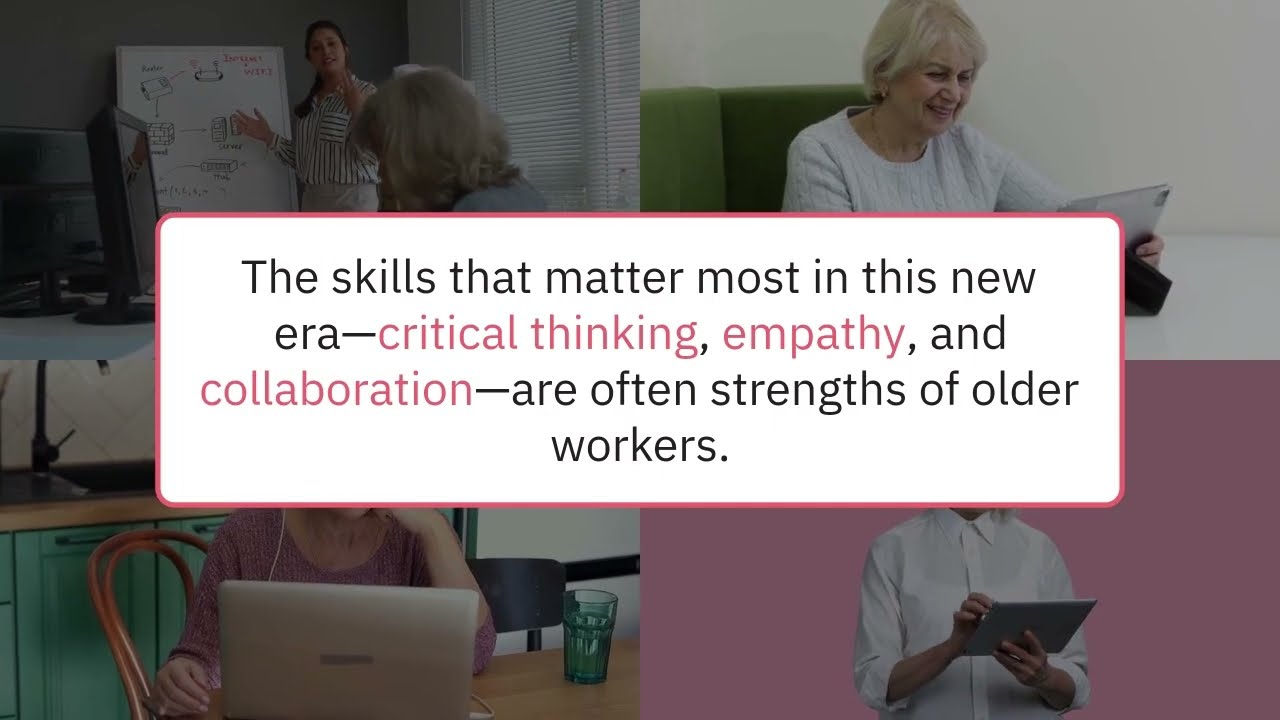
Traditionally, careers have been segmented into three stages. From 20-30 usually the beginning, 30-45 mid-career, and 45-65 ending or retirement. This is now one called Legacy Careers, which is for 50-75. The older worker also seems to bring with them the interpersonal skills needed, even in the growing age of Artificial Intelligence (AI). Skills like critical thinking, problem solving, listening, empathy, and relationship management, among others, that the younger generations are seen to be lacking.
Bottom line, most of the world population is aging, there are declining birth rates, an increase in life expectancy, and a reframing of what it means to be older in these times. A megatrend that will continue for decades to come.
The Growing era of AI
The exponential growth of AI is poised to create a whole new way of working. One example is the magazine Artificial Intelligence. It came out in 2025, and in the very first magazine, the editors wrote that the articles were written by AI, and then they reviewed it, edited it, and corrected it. Or as I like to say, humanized it. This shows one impact on the career and profession of writing and writers.
The biggest concern is all of the jobs AI might eliminate or impact. However, if we look at history, when the PC came out, now it seems like a hundred years ago, last century, it eliminated 3.5 million jobs and created 19 million jobs. AI is expected to eliminate over 90 million jobs and create 170 million jobs by 2030.
Unfortunately, some companies jump out ahead of everyone else without perhaps considering their human capital strategy and other ramifications. For example, IBM laid off 8000 employees because of AI, only to have to rehire them because of AI. And this is just one example of several. Even companies like Microsoft, which is investing heavily into AI, recognizes that the crucial skills needed in the future will be the interpersonal skills, like critical thinking, collaboration, and listening, among others. Skills that the older worker has had time to learn, apply, and work on over their long careers. This has led some to challenge this thinking by reminding us that AI is a tool, not a replacement for our brain, and if acceptance of AI is slow, it is not an AI problem, but a leadership problem.
Leadership Implications
We have learned from neuroscience and NeuroLeadership that our brain needs a leader to create an
environment that feels safe and certain, and one who communicates well. This when AI is creating a lot of uncertainty, and we are not neurologically wired for uncertainty. It has noted that most resist
change because they do not like it or understand it. A leader plays a key role in this space by communicating the expectations of AI and how it will impact everyone’s role. Unfortunately, in the book “The Mind of a Leader”, a study highlights how only 5% of leaders are effective communicators.
Leaders also need to be aware of their own unconscious biases. We all have them. But if these biases allow leaders to make decisions based on myths and stereotypes of an aging workforce, they will be missing out on a growing segment of the workforce and consumer. The research keeps showing us that diverse teams (that include multi-generational, older, multi-cultural workforce) outperform non-diverse teams when it comes to making decisions, positively impact revenue, profitability, and lead to lower turnover. All factors that have bottom-line implications.
Leaders might want to consider the 5 key roles they will play in their organizations. They are celebrities because everyone is watching what they say and do. Quasi-psychologist, because you bring who you are, good, bad, and indifferent, to every interaction you have. Quasi-sociologist because of team dynamics and anthropologist because of organizational culture. And last, the conductor of an Orchestra, because just as this individual has to get beautiful music from different musicians using different instruments, you as a leader need to get the best from your diverse team (irrespective of age) to achieve the business results your organization is striving for.
Leaders need to remember that their mind determines their choices, their choices determine their
actions, and their actions shape their leadership. In summary, today and tomorrow, organizations will
be different. In the growing era of AI, present and future organizations will require more humans
(including older workers), not less.
ABOUT THE AUTHOR
Edwin Mourin᷁o – Ruiz, Ph.D.
Dr. Edwin Mouriño is an Air Force veteran, author, Human Capital, and DEI practitioner and speaker. As a human capital practitioner, Dr. Mouriño’s focus has been on helping leaders and organizations help themselves. He is an experienced professional with many years of leading and/or supporting key elements of organizational change projects. Dr. Mouriño is an Air Force veteran who began his career in Diversity Equity and Inclusion (DEI) as a graduate of the DOD-Defense Equal Opportunity & Management Institute (DEOMI) and has also been a speaker.
He brings broad industry experience that includes Fortune 100 companies. He is the founder and president of Human Intelligent (HI) Workplace, an organization focused on helping leaders help themselves through leadership, team development, and executive coaching. He has been and continues to serve as a college professor. He is also a Senior Fellow with the Conference Board on the DEI and Leadership Steering Committees.
He has extensive experience and thought leadership on Human Capital issues and supported organizational change efforts through Leadership Development, DEI, Executive Coaching, Team Development, Executive Retreats, Personality Assessments, and Organizational Change. He has spoken at numerous professional venues and written numerous articles on human capital trends impacting organizations, specifically addressing DE, and is the author and co-editor of several books.

0 Comments