Leadership can be Inspirational and Influential

Inspirational Leadership
HI

Human Intelligent (HI) Workplace
Helping Leaders Help Themselves

July 23, 2026

You might be wondering why this title. After having spent over 40 years in the workplace, from my part-time beginnings while in high school and college, and part-time jobs while in the Air Force, along with my time in the Air Force and several corporate settings along the way, I’ve come to accept that leadership can be inspirational and influential. I’ve worked for many managers over my life, but only 5 stand out as being both inspirational and influential for me.

In the book, Jesus, CEO: Using Ancient Wisdom for Visionary Leadership, the author highlights that Jesus’s mission was to teach people a better way of life. I believe that in an organization, a leader’s role is to create a better way of work for his/her workforce while they work to achieve organizational goals and deliver on their services or products. One way to do this is to be both inspirational and influential.

Research has shown us many times over that a bad boss can lead to disengagement, costing companies trillions, and that work is the 5th leading cause of death due to stress. More importantly, for 70% of the workforce, their boss is their biggest stressor. This has caused what I’ve come to notice as a workforce on their way to work looking like working zombies. They seem to be on their way to a place they’d rather not be at, doing something they’d rather not do, and working for someone they’d rather not work for. Allowing this type of workplace to exist is not inspirational and just plain draining.

Research tells us that people are looking for autonomy, purpose, and mastery. They do not want to be micromanaged, want to do something bigger than themselves, and want to continue to learn. The number one thing they want is to be appreciated, a simple thank you, while pay is number eight. In essence, they want to be happy at work, where they are expected to spend over 90,000 hours of their adult waking life. 

When the workforce has high trust, they experience less stress, higher productivity, and less burnout. They are less likely to be sick, less absent, and more loyal. This has organizational bottom-line implications and positive results for the workforce. This is partly driven by a leader who inspires the workforce. In the book, The Art of Happiness at Work, Dalai Lama says that happiness at work, leads to happiness in life. I believe this why work-life balance has evolved to work-life integration, especially after the pandemic.

Just like Jesus inspired and reached his 12 apostles, who were normal, sometimes insecure, humble men who were not sure what they were getting into or if they could do it. But as they watched Him, they learned, even when making mistakes.  He led them through His mission so they could go on after he was gone. While they may have their own version of imposter syndrome, Jesus led them to go beyond what they ever thought they could.

To a certain extent, a leader is like a celebrity, because everyone is watching what they say and do. The apostles did the same. A leader plays a quasi-psychologist, because they show up with their own limitations and deal with workers who show up with theirs. A quasi-sociologist because they have to create a team. A quasi-anthropologist who creates an environment or culture where everyone can feel part of and not excluded, participate, and remain engaged. Last, like a director of an orchestra who brings beautiful music from different instruments and musicians, a leader needs to tap into their diverse team and bring out their best to deliver on the products and/or services of the organization. In order to complete these roles, they need to inspire the workforce. 

Peter Drucker, considered by some the father of management, has been credited with saying that “management is doing things right, while leadership is doing the right things”.  As I’ve taught many the topic of leadership and have been myself in a managerial role, I have mentioned that there are a lot of managers but few leaders. We need both, but we need a bigger emphasis on leadership. This means doing the right things can help a leader to create a healthy environment by being both inspirational and influential.

I define leadership in the following manner:

The capacity of an individual in a managerial position to positively influence, engage, and motivate their workforce.  One where they demonstrate empathy, compassion, listen to understand, rather than respond, is trustworthy, authentic, and creates a psychologically safe environment.  One where they create clarity and minimize uncertainty as much as possible during organizational change.  In summary, a leader is one who creates an environment where the workforce feels engaged.

If your workforce read the above, would they agree that the definition describes their leaders or you? If not, why not? I believe that if leaders demonstrate some semblance of the above, it can better position them to be inspirational and influential. In order to do this, leaders need to communicate effectively and listen to understand. 
Lead-mot-power Leadership can be Inspirational and Influential

Inspirational and influential leaders are empathetic, which means they are leaders who work to understand the other person’s point of view, especially when they have concerns. They are compassionate, which means they offer ways to help or ask how they can help. And last, they work to be authentic, so that those around them understand how humane and considerate they are. This is especially important in an environment that can be demanding and stressful, such as work. In other words, they are leaders who people like working for and can be perceived as inspirational and influential leaders.

This is particularly important when societies and organizations need to always be adapting and changing. Change creates uncertainty, something that neuroscientist tell us our brain is not wired for. Our brain is wired for routine and predictability. So in times of uncertainty, which has always and will always exist, being true to oneself, believing the best of humanity, and being authentic can lead to being inspirational and influential. This is something that Artificial Intelligence (AI) is not expected to replace any time soon.

There are many leaders in history who have been both inspirational and influential from all walks of life. They include people like Mother Theresa, Presidents Lincoln, Eisenhower, and Kennedy, Gandhi, Marcus Aurelius, Nelson Mandela, Martin Luther King, Jr., Simon Bolivar, Walt Disney, Dalai Lama, and Jesus, among others. 

Leadership-is-not-power-300x172 Leadership can be Inspirational and Influential

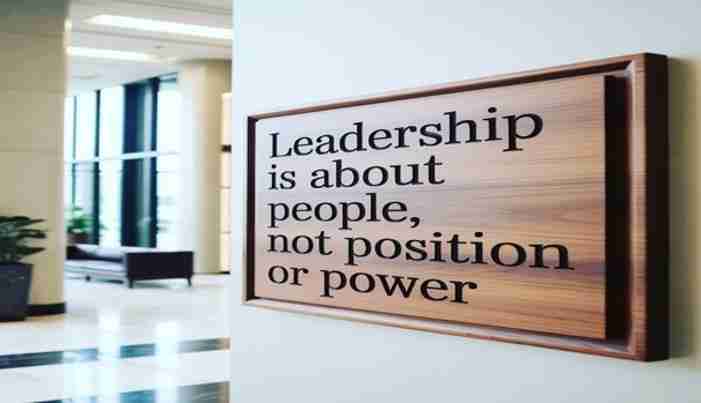
But as the picture highlights above. Before you can lead others in an inspirational and influential manner, you need to be clear with yourself, believe in what you are doing, be committed to it, and open to learning along the way. Reflect on the names I mentioned above. They faced many challenges but believed in what they stood for and what they were pursuing. Because leadership is about continually learning. Reflect on what you’ve read. What jumps out at you? What resonates for you, and what can you do as you continue in your leadership journey? I wish you the best.

As Mr. Spock would say: “live long and prosper”.
 

ABOUT THE AUTHOR
Edwin Mourin᷁o – Ruiz, Ph.D.

Dr. Edwin Mouriño is an Air Force veteran, author, Human Capital, and DEI practitioner and speaker. As a human capital practitioner, Dr. Mouriño’s focus has been on helping leaders and organizations help themselves. He is an experienced professional with many years of leading and/or supporting key elements of organizational change projects. Dr. Mouriño is an Air Force veteran who began his career in Diversity  Equity and Inclusion (DEI) as a graduate of the DOD-Defense Equal Opportunity &  Management Institute (DEOMI) and has also been a speaker.

He brings broad industry experience that includes Fortune 100 companies. He is the founder and president of Human Intelligent (HI) Workplace, an organization focused on helping leaders help themselves through leadership, team development, and executive coaching. He has been and continues to serve as a college professor. He is also a  Senior Fellow with the Conference Board on the DEI and Leadership Steering  Committees.

He has extensive experience and thought leadership on Human Capital issues and supported organizational change efforts through Leadership Development, DEI,  Executive Coaching, Team Development, Executive Retreats, Personality  Assessments, and Organizational Change. He has spoken at numerous professional  venues and written numerous articles on human capital trends impacting organizations, specifically addressing DE, and is the author and co-editor of several books.

You May Also Like...

0 Comments